
What It Really Means for Your Running, Your Body, and Your Performance
Most runners don’t think about heel drop when they buy shoes. They look at cushioning, colour, weight, maybe even carbon plates — but heel drop? It’s usually an afterthought.
Yet that tiny number — 0 mm, 4 mm, 8 mm, 12 mm — quietly shapes how your body moves, how your muscles load, and how your stride feels.
It’s one of the most misunderstood parts of shoe design, and one of the most influential.
This guide breaks down heel drop in a way that actually matters for real runners: not the lab‑coat version, but the practical, “how does this affect my training tomorrow?” version.
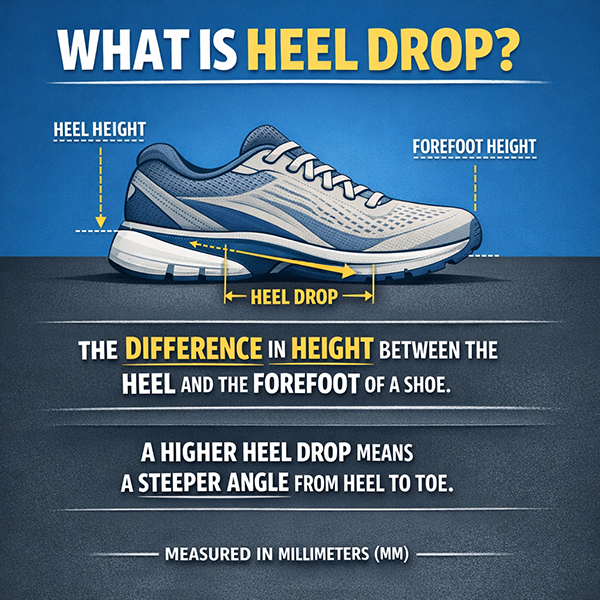
What Is Heel Drop? (And Why It Matters More Than You Think)
Heel drop is simply the difference in height between the heel and the forefoot of a running shoe.
If the heel sits 12 mm higher than the forefoot, that’s a 12 mm drop. If they’re level, that’s 0 mm.
But the number itself isn’t the point — it’s what that number does to your body.
A higher heel drop tips you slightly forward and cushions the heel.
A lower heel drop flattens the shoe and encourages a more natural foot strike.
Neither is “better.” They just load your body differently.
And if you’re a runner who’s ever dealt with tight calves, sore Achilles, cranky knees, or inconsistent stride mechanics, heel drop is a variable worth paying attention to.
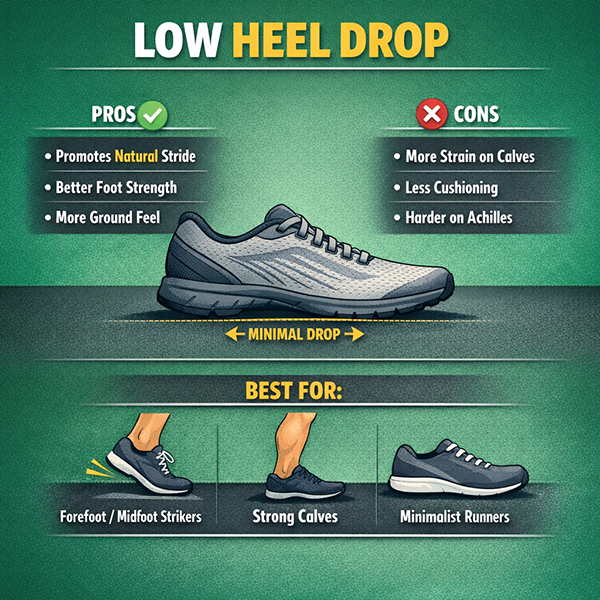
Low Heel Drop (0–4 mm): Natural, Engaging, Demanding
Low‑drop shoes sit closer to the ground and encourage your foot to do more of the work.
They’re popular with trail runners, minimalist runners, and anyone who likes a more “connected” feel.
How Low Drop Changes Your Running
A lower drop shifts load toward the calves, Achilles, and foot muscles.
This can be a good thing — it builds strength and encourages a more efficient midfoot or forefoot strike.
But it also means your lower legs are doing more of the heavy lifting.
Why Runners Choose Low Drop
- They want a more natural stride
- They want to strengthen their feet and calves
- They prefer ground feel and stability
- They run trails where proprioception matters
Where Low Drop Can Backfire
If your calves aren’t conditioned, or if you’ve had Achilles or plantar issues, low‑drop shoes can expose weaknesses quickly.
It’s not that low drop is “bad” — it’s just demanding.
The Coaching Perspective
Low‑drop shoes are brilliant when they match the runner.
They’re not a magic fix for form, and they’re not a shortcut to efficiency.
They’re a tool — and like any tool, they work best when used intentionally.
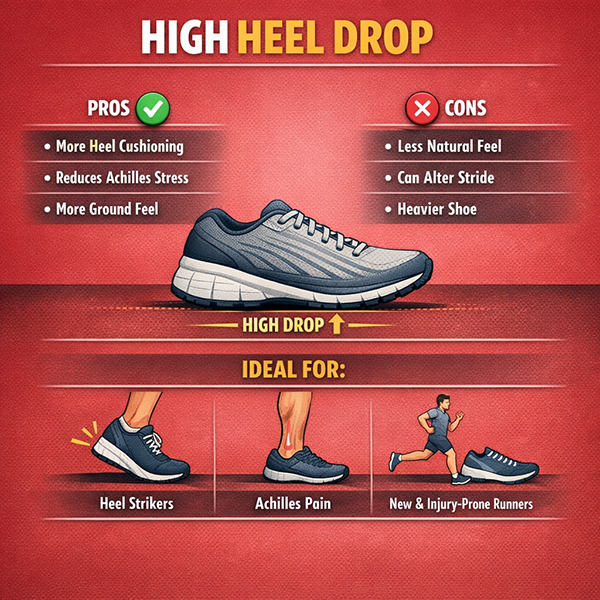
High Heel Drop (8–12 mm): Cushioned, Forgiving, Supportive
High‑drop shoes are the comfort zone for most runners.
They’re cushioned, protective, and easier on the lower legs — especially during high‑volume training.
How High Drop Changes Your Running
A higher drop shifts load away from the calves and Achilles and toward the knees and hips.
This can make running feel smoother and more forgiving, especially if you’re a heel striker.
Why Runners Choose High Drop
- They want more heel cushioning
- They’re managing Achilles or calf tightness
- They’re beginners building base fitness
- They want comfort on long or easy runs
Where High Drop Can Backfire
It can encourage over‑striding or a heavy heel strike if the runner relies on the cushioning too much.
It can also reduce ground feel and responsiveness.
The Coaching Perspective
High‑drop shoes are incredibly useful — especially for newer runners, heavier runners, or anyone in a rehab phase.
They’re not “less natural.” They’re simply more protective.
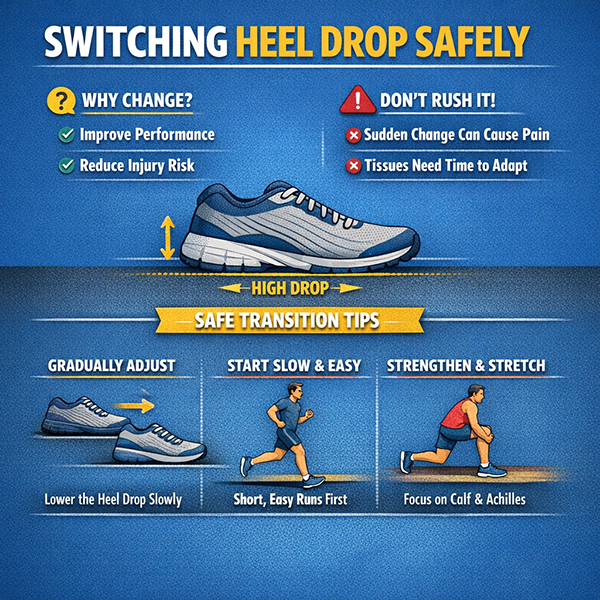
Why You Might Want to Change Heel Drop
Runners usually change heel drop for one of three reasons:
1. Performance
Some runners feel more efficient with a lower drop because it encourages a quicker cadence and midfoot strike.
2. Injury Prevention
Achilles issues? Higher drop often helps.
Knee issues? Lower drop sometimes reduces load.
It’s not a rule — but it’s a pattern worth exploring.
3. Comfort
Sometimes a shoe just doesn’t feel right.
Heel drop is often the hidden reason.
The Coaching Perspective
Changing heel drop is less about chasing trends and more about matching your shoe to your stride, your training phase, and your injury history.
—
How to Transition Safely (The Part Most Runners Skip)
This is where runners get into trouble.
They switch from 10 mm to 0 mm overnight and wonder why their calves feel like they’ve been hit with a hammer.
Heel drop changes how your tissues absorb load.
Your muscles adapt quickly.
Your tendons adapt slowly.
1. Adjust Gradually
Drop by 2–4 mm at a time.
Alternate between old and new shoes for several weeks.
2. Start With Easy Runs
Short, slow, conversational runs only.
No speed work. No hills. No long runs.
3. Strengthen the Lower Legs
This is non‑negotiable.
Calf raises, eccentric heel drops, ankle mobility — these are your insurance policy.
4. Listen to Your Body
Mild tightness is normal.
Sharp pain is not.
If something feels wrong, pause the transition and reset.
Pull‑quote:
Your enthusiasm adapts faster than your tendons. Respect the timeline.
—
Why You Shouldn’t Rush the Process
Your body is incredibly adaptable — but it adapts on its own schedule.
Tendons, fascia, and connective tissues remodel slowly.
A rushed transition can overload the Achilles, calves, or plantar fascia.
A safe transition takes 6–8 weeks, sometimes longer.
Think of it like progressive overload in the gym — you wouldn’t jump from 60 kg to 120 kg in a week.
—
The Bottom Line: Heel Drop Is a Tool, Not a Personality Trait
There’s no “right” heel drop.
There’s only the heel drop that works for you, your body, your stride, and your training goals.
Low drop can make you feel agile and connected.
High drop can make running feel smooth and forgiving.
Most runners benefit from using both across different phases of training.
If you’re thinking about changing heel drop, do it intentionally, do it gradually, and support your body with strength work.
—
Want Help Choosing the Right Shoe for Your Running Style?
This is where coaching makes a difference.
If you want personalised guidance on:
- choosing the right heel drop
- transitioning safely
- building calf/Achilles strength
- improving your running form
- structuring your training around your shoe choices
You can explore my coaching options here: